
Youth as Architects of Belonging
Executive Summary
By Rheanna Ganapathy, Fahima Islam, Sidra Shabbir, Jennifer Dworkin, Cecilie Surasky & Charlotte O’Keefe
Purpose of this Study
Over the past two decades, a striking convergence across neuroscience, developmental psychology, education research, and political science has revealed that belonging is essential for the healthy development of young people and the flourishing of a pluralistic democracy. Without it, learning stalls, civic participation falters, loneliness increases, and young people’s potential is quietly and sometimes irrevocably lost.
This project supports efforts to align the education and child development fields at a unique moment in history when youth are experiencing an unprecedented crisis of belonging. Never have so many young people — especially the most vulnerable — felt that they don’t belong. Depression, anxiety, absenteeism, suicidality, economic and housing stress, and attacks on history, books, and identities are all at historic highs.
Our vision is a world where all people belong, and no one is othered: where children and young people can flourish as learners, friends, and eventually as engaged citizens in a diverse democracy. This study identifies youth-serving institutions as the sector with the greatest potential to make belonging a global norm.
How can the adults entrusted with youth care — parents, educators, coaches, librarians, community leaders, and policymakers — ensure that young people feel a sense of belonging in their daily lives? We wrote this report for those who have a genuine desire to improve outcomes for young people and a willingness to listen deeply and co-design belonging structures with them.
This study seeks to expand the adoption of belonging design in youth-serving institutions by centering young people as insightful and creative architects of their own world. It was designed to produce easily understandable research that documents the critical elements needed to foster belonging and provides actionable insights for creating cultures of belonging through a Youth Participatory Action Research (YPAR) approach.
Why YPAR?
Youth Participatory Action Research is a process through which young people identify problems in their communities, conduct research to understand them, and take action to address them. We adopted YPAR as a critical methodology for gaining authentic insight into the lived experiences of young people. Beyond gaining insights about the social and emotional terrain of youth life, our research additionally revealed YPAR to be a uniquely powerful mechanism for cultivating the very sense of belonging we sought to study.
YPAR is a valuable tool for youth belonging because it directly confronts the structures of othering:
- It is a mechanism for expressing agency and power. Youth become the researchers rather than the subjects of research. They are centered as the foremost experts on their own conditions, wants, and needs and become co-creators of knowledge and change.
- It challenges soft breaking. By conducting rigorous research and presenting solutions, youth demonstrate their competency. This directly challenges societal tendencies to view struggling young people especially as problems to be solved or as two-dimensional stereotypes.
- It builds bridges. YPAR requires young people to engage with those they might otherwise see as others — city officials, older generations, peers from different backgrounds — practicing the willingness to recognize shared humanity across differences.
- It builds democracy. Good data, communicated clearly, is the foundation of most meaningful change efforts. YPAR helps students exercise their democratic capacities, revealing the agency they possess to enact change.
Although this choice significantly increased the complexity of obtaining Institutional Review Board (IRB) approval from UC Berkeley and extended the project’s duration, we did not choose YPAR out of academic preference. It was a methodological and ethical imperative. For that reason, we have converted our YPAR tools into an open-source curriculum available to anyone and made the widespread use of YPAR itself one of our critical recommendations for belonging.
What is Othering and Belonging?
According to the Othering & Belonging Institute at UC Berkeley, othering is a set of processes that treat certain people as less deserving, less capable, or not belonging to the group. It is not just about noticing differences; it is about using those differences to deny people equal dignity. In the context of youth, this often looks like soft breaking, a form of othering where we treat young people as likable but incompetent. Because adults often don’t trust youth’s competence, they limit their participation and don’t allow them to help create the rules they live by.
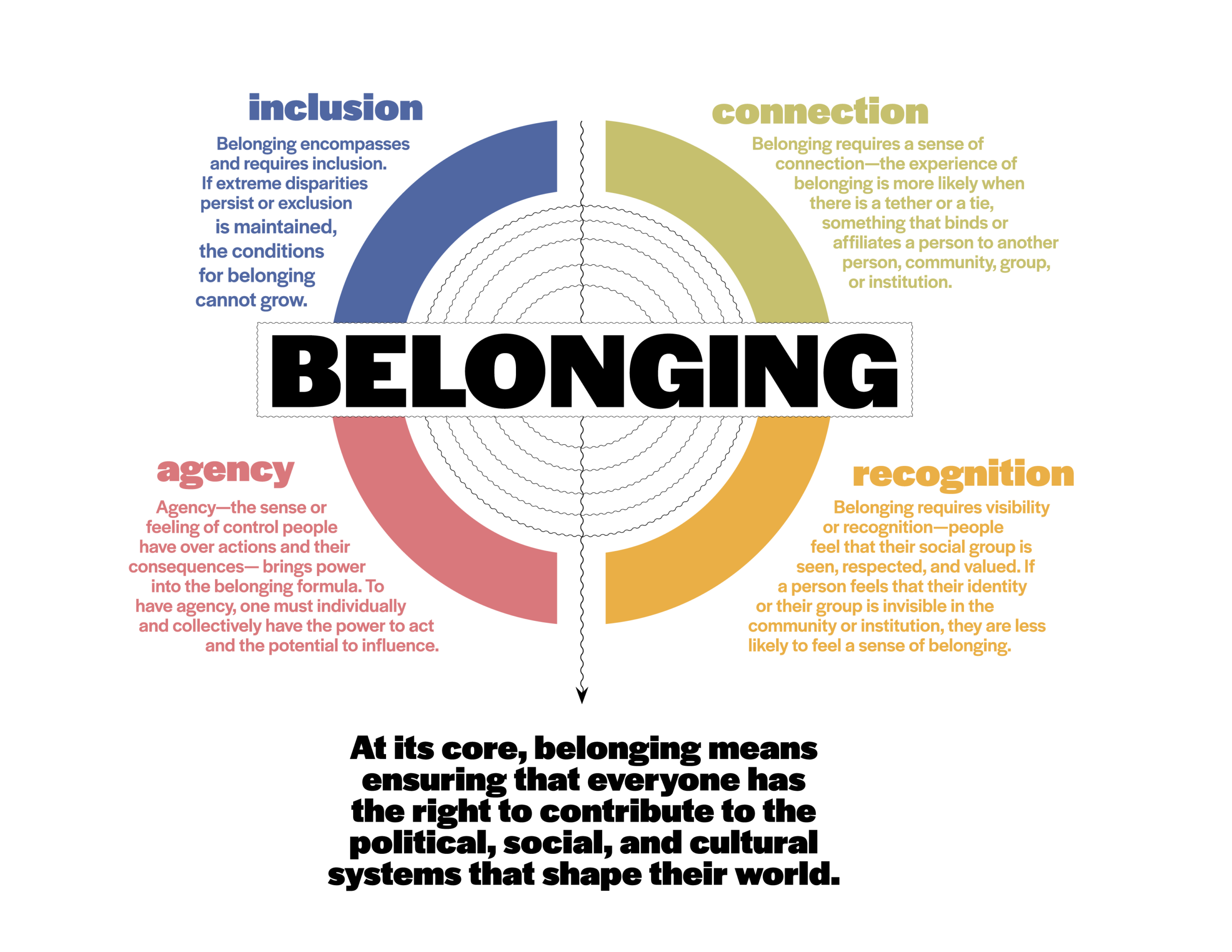
Belonging, on the other hand, is more than just being included in an existing group. True belonging means you have the agency and power to help co-create the world you live in. It requires that every person be seen as an equal who can participate in making decisions for the future. The four pillars of belonging are inclusion, connection, recognition, and agency.
Belonging is not a nice-to-have feeling or only a social-emotional goal. It is a biological necessity for learning. When a young person feels they truly matter to the people around them, their brain releases chemicals like oxytocin and dopamine that support focus, memory, engagement and motivation. When they feel othered or ignored, their brain’s stress response stays on high alert and chronic cortisol exposure hijacks the neural systems needed for learning and decision-making. You cannot teach a child when their brain is in survival mode.
The Present Study
In this study, the Perception Institute and the Othering & Belonging Institute partnered with two youth-serving organizations (Maysles Documentary Center and the YMCA Detroit) to conduct a Youth Participatory Action Research study exploring the following question: What helps young people feel a sense of belonging, where they feel seen, respected, and empowered?
Within each organization, staff liaisons recruited a small cohort of youth researchers aged 13-26 to work with our team to co-design the study. Through a series of educational Information sessions, we taught the youth researchers crucial research skills, and worked with them as they developed testable hypotheses, created survey and focus group questions, and facilitated focus groups with their peers. Youth researchers collaborated within their cohort at each organization and reflected on their journeys as researchers along the way. We disseminated the survey they designed to participants at youth-serving organizations across the country, and the youth researchers conducted the focus groups with their peers at their organizations.
We then collected, analyzed, and synthesized all data from the survey, focus groups, and researcher reflection forms to understand the key elements that contribute to a strong sense of belonging among youth. We distilled these themes into five critical insights, which, along with extant research, we used to develop a set of recommended practices for youth-serving organizations to create spaces that empower youth in their communities to foster belonging among peers more effectively.
Deliverables
This study will produce the following applied tools to support belonging efforts for youth; see Appendix F for an early, in-development version of the deliverables:
Educational Video Module: The video will follow the youth researchers as they investigate what fosters belonging among their peers, showing the YPAR process as one of empowerment and co-creation, and presenting the research findings and recommendations uncovered through this youth-led research.
YPAR Kit: The curriculum guides, worksheets, slide decks, and other materials used in this study will be templated and packaged into a kit for conducting a YPAR study on belonging at any youth organization.
Social Media: Reels, diagrams, tailored executive summary, and quote cards for partner dissemination via trainings and social media, email newsletters, etc., featuring simple, clear principles and youth quotes for creating belonging.
Read the Full Report here