Mapping Perceptions in America (Racial Ideology)
We regularly see headlines proclaiming that our demographics predict our beliefs and behavior. Common refrains include: “many dimensions of racism are invisible to white people,” and “Republicans (are) ‘afraid of women voting.’” These headlines suggest that people hold monolithic views with others who share their identities. The Perception Institute has embarked upon a Perception Mapping Project to empirically study whether our social identities predict our perceptions of ourselves and others — and if not, what exactly does shape our values, attitudes, and political behaviors.
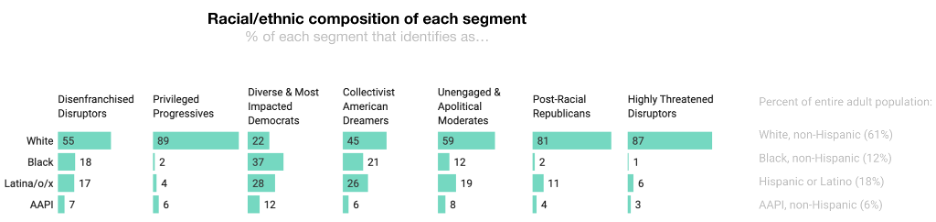
The first project, Racial Ideology Mapping, was conducted in partnership with PerryUndem and the ACLU. We set out to identify and measure the underlying belief systems that shape how people understand race and identity, and how these beliefs relate to policy, political attitudes, and behavior – what we call Racial Ideology. These fundamental questions include: What shapes the way people think about race? What are their experiences with people who share their racial or ethnic background, and those who don’t? How do these experiences affect their political beliefs and attitudes? And do people’s racial ideologies map onto their races and ethnicities?
Using in-depth qualitative inquiry paired with a national survey, this study reveals: